

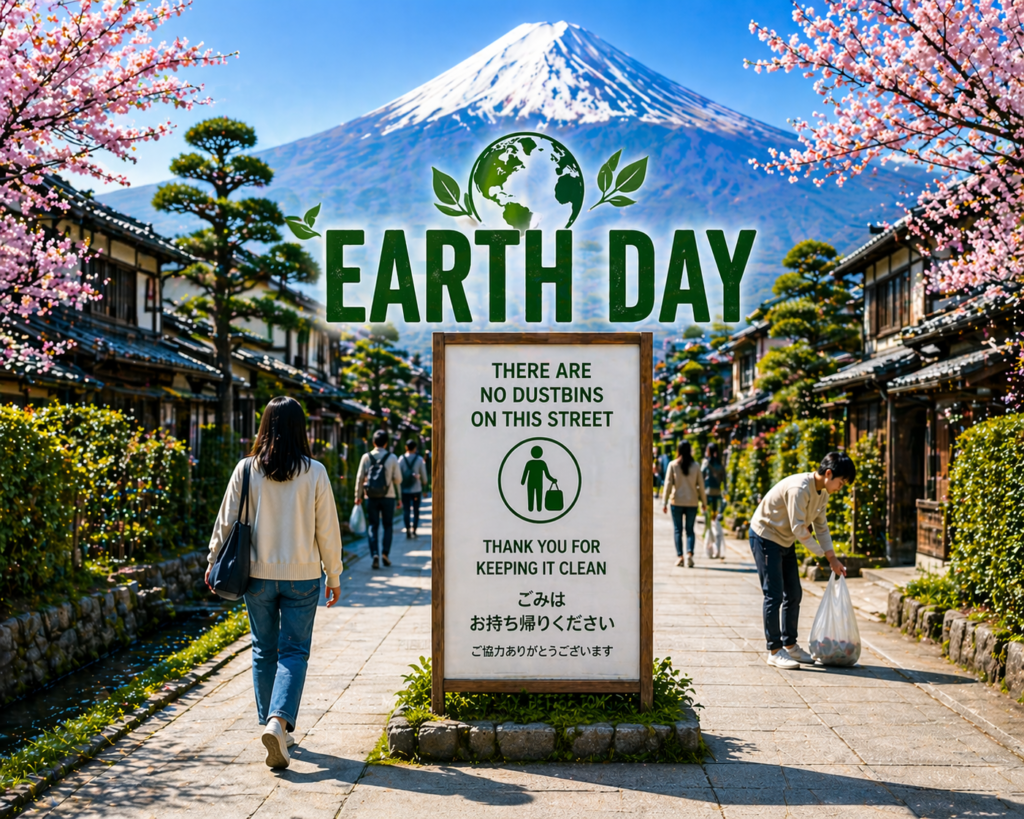
I was in Japan recently, and something felt… different.
It wasn’t the architecture.
It wasn’t the technology.
It was something much simpler.
There were no trash cans.
Not on the streets.
Not in public spaces.
Not even in places where you would expect them.
And yet – not a single piece of garbage anywhere.
In most countries, fewer dustbins would mean more litter.
In Japan, it means the opposite.
People don’t throw things “away” – because there is no “away.”
They carry their waste with them.
Wrappers, bottles, packaging – everything goes into a small bag, often kept in a backpack or purse. And when they reach home, they dispose of it properly, sorting it into burnable, non-burnable, and recyclable categories with remarkable discipline.
No one is watching.
No one is enforcing it.
And yet, everyone follows it.
The difference isn’t infrastructure.
It’s mindset.
In Japan, cleanliness is not outsourced to the government, municipal workers, or “the system.”
It’s personal.
There’s an unspoken social contract:
If you create waste, you are responsible for it.
Littering isn’t just discouraged — it’s socially unacceptable. A quiet but powerful cultural norm.
Now contrast that with what we see every day.
A car window rolls down — and a plastic bottle flies out.
A snack wrapper gets dropped because “there’s no dustbin nearby.”
Tourist spots filled with more trash than tourists.
We don’t do it out of malice.
We do it out of habit.
Every year on Earth Day, we talk about saving the planet.
We share posts.
We talk about climate change.
We discuss policies and sustainability.
But what if the real problem isn’t a lack of awareness?
What if it’s a lack of ownership?
Because here’s the uncomfortable truth:
The planet isn’t being destroyed by a few big actions.
It’s being eroded by millions of small, daily ones.
What Japan demonstrates is not a technological solution.
It’s a behavioral one.
No new systems.
No complex infrastructure.
Just a simple shift:
Take responsibility for what you consume.
Imagine if we adopted just one habit:
Carry your waste. Don’t throw it.
Not because there’s a fine.
Not because someone is watching.
But because it’s the right thing to do.
This Earth Day, instead of asking:
“How do we save the planet?”
Maybe we should ask:
“What am I doing – every single day – that’s harming it?”
Because the planet doesn’t suffer from a lack of campaigns.
It suffers from a lack of consistent action.
Maybe Earth Day isn’t about saving the Earth.
Maybe it’s about changing how we behave on it.