

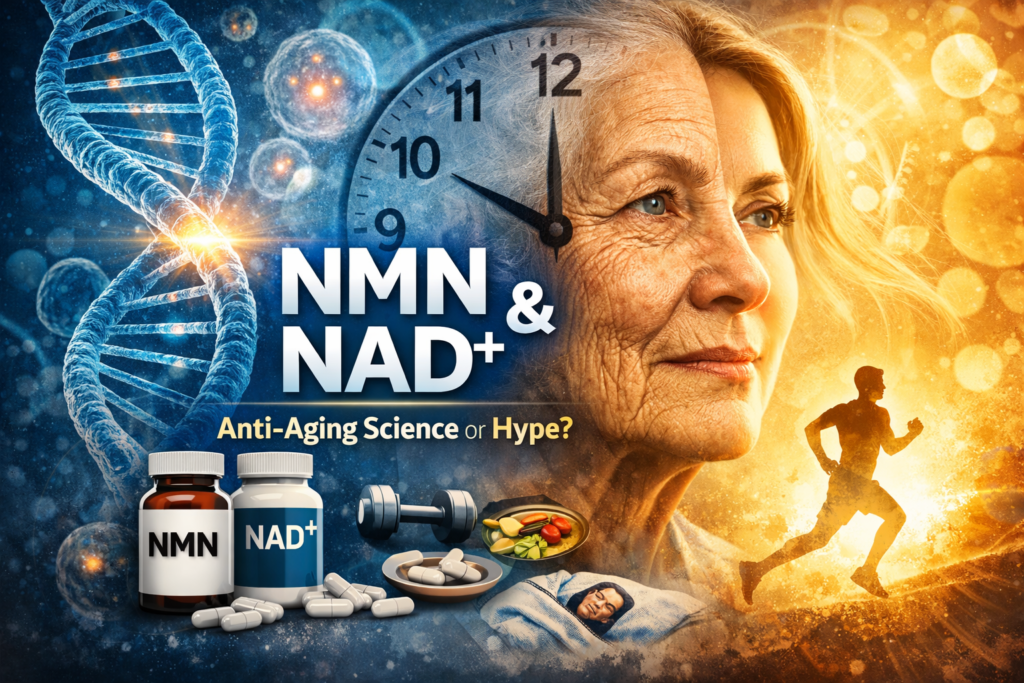
You’ve probably seen NMN or NAD⁺ all over social media. Biohackers are talking about it. Influencers are calling it the “anti-aging” supplement.
But let’s break it down simply.
Your body runs on energy at the cellular level. NAD⁺ – short for Nicotinamide Adenine Dinucleotide – is a molecule that helps your cells turn food into energy. It also helps repair damaged DNA and keeps your cells functioning properly.
The problem? NAD⁺ levels naturally drop as we get older.
NMN – Nicotinamide Mononucleotide – is a compound that helps your body make more NAD⁺. So the idea is simple: if NAD⁺ drops with age, maybe boosting it could help us age better.
In animal studies, especially in mice, increasing NAD⁺ looks promising. Mice had better metabolism and signs of healthier aging.
In humans, early studies show that NMN can increase NAD⁺ levels and may improve things like muscle performance and insulin sensitivity.
But here’s the important part — we do not have proof that it helps people live longer.
Research suggests that NAD⁺ levels decline with age — with some human tissue studies reporting reductions of roughly 30–50% in older adults compared to younger individuals (see review in Cell Metabolism: https://www.ncbi.nlm.nih.gov/pmc/articles/PMC7442590/). This biological decline is one reason scientists are exploring NAD⁺ precursors like NMN.
In human trials, NMN has been shown to increase blood NAD⁺ levels. For example, a randomized controlled trial published in Frontiers in Aging found that daily NMN supplementation significantly raised NAD⁺ concentrations and improved certain physical performance markers over 60 days (PubMed link: https://pubmed.ncbi.nlm.nih.gov/36482258/).
Other clinical research with NAD⁺ precursors such as nicotinamide riboside has demonstrated measurable increases in circulating NAD⁺ levels within weeks (study overview in Nature Communications: https://www.nature.com/articles/s41467-018-03421-7).
However — and this is critical — none of these studies demonstrate increased human lifespan. Most trials are short-term and focus on safety, biomarkers, or metabolic parameters. Long-term data on mortality or true aging outcomes simply does not exist yet.
It’s interesting science. It’s promising. But it’s not a magic anti-aging shortcut.
If you’re young, your biggest longevity tools aren’t supplements — they’re sleep, exercise, strength training, good nutrition, and stable mental health.
Supplements can support health. They don’t replace fundamentals.
Stay curious. But always ask: what does the evidence really say?