


I’m in Delhi from today, and as always, this city feels like home. On Saturday, 31 October, 21 Days to Good Health has its Delhi launch. Read about the launch here → I know not everyone can be in the room, so I’ll be sharing moments from the launch and the days around it with all of you.
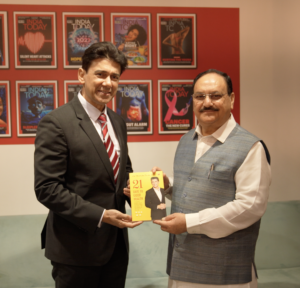
While in Delhi, I joined the Aaj Tak Health Summit, hosted by The Health Wealth Channel. One of my proudest moments was presenting a copy of the book to Shri J P Nadda, India’s Health Minister. The rest of the hour was a conversation with a young, curious audience, and their questions were fantastic. Here are the highlights.
“Can 21 days really change your health?”
We almost poked fun at the title ourselves. The 21-day idea goes back to Maxwell Maltz, a plastic surgeon in the 1960s who noticed it took his patients about 21 days to get used to their new faces. More recent research suggests that forming a habit takes closer to 59 to 66 days.
But here’s what I believe: every journey starts with one step, and 21 days is attainable. You start seeing changes as soon as you make changes. So I built the book around five pillars, in plain language rather than medical jargon, to get you through the first 21 days. After that, the experiment is your life.
Healthspan over lifespan
Everyone is talking about living to 150. My view is simple: if the last 20 years of a 100-year life are spent bedridden, with a diaper and a feeding tube, that isn’t life. I want you to put more life in your years, not just years in your life. That means being on your own two feet, independent, with a brain, body and purpose that all still work.
I operated on around 10,000 patients over 20 years. I could save lives with millimetres and milliseconds, but I couldn’t turn back the clock on 20, 30 or 40 years of bad living. I also couldn’t scale: at best, 500 open-heart cases and 2,000 consults a year. So I wrote this book to give people what I wish I could have handed my patients decades earlier. The goal is to move the pendulum from acute care to prevention, early recognition and early treatment.
What Madhuri and I do at home
The five pillars are nutrition, movement, sleep, stress and mindset, and community and purpose. Here’s how they show up in our house:
- Phones in a tray at the dinner table. Everyone puts them away.
- Walks after meals. Fifteen minutes, three times a day. Leaving your shoes by the door makes it automatic.
- Things we love doing together. We play tennis, jam with music, cook, walk the dogs and race cars. Madhuri loves to dance, and my spin class plays loud Bollywood music and makes fun of each other.
Loneliness is a disease. In the Blue Zones, community was one of the pivotal factors among people who lived past 100. As families get busier and OTT pulls us apart, we have to protect it.

The Indian plate, sugar and “this vs that”
South Asians are at higher risk for diabetes and heart disease. We moved from an agrarian life of manual labour to desk jobs and fast delivery, and our diets haven’t caught up. But you don’t have to give up Indian food. The plate in the book is:
- Half: fibrous vegetables
- A quarter: protein
- A quarter: non-refined complex carbohydrates
On sugar, try no added sugar in your tea or coffee for a week, then 14 days, then 21. The craving fades. “Sugar-free” isn’t a magic fix either, because some sweeteners can spike insulin, and a diet Coke beside a huge meal doesn’t change much. Naturally occurring sugar in fruit is fine.
And you don’t have to give up your favourite foods. In my This vs That videos, I rebuilt vada pav with sweet potato instead of potato, millet pav and air-frying or baking instead of deep-frying. People preferred it. I did the same with sooji halwa, using cashew butter and monk fruit instead of added sugar.
Why the scale and BMI can mislead
A weightlifter can have a “high” BMI simply because muscle is heavy, and that isn’t unhealthy. Waist-to-hip ratio is a better predictor, and no single number should be read in a vacuum. Many Indians also carry significant visceral fat at lower BMIs, the “skinny fat” pattern, so how you look doesn’t tell the full story.
Blood tests, wearables and supplements
When I trained in the ’90s, 80% of a diagnosis came from history and physical examination. Today, tests are sometimes ordered before the patient is even seen, and it becomes a fishing expedition. A normal test doesn’t always mean you’re fine, and trends matter more than a single data point. Order a test only if the result will change what you do. For example, if a first-degree relative has heart disease, your risk is four to ten times higher, and a workup makes sense.
Wearables are like a car dashboard: useful, but not the whole picture. On supplements, don’t replete what isn’t deficient, and be sceptical of hype on social media. I took the Hippocratic oath, “above all else, do no harm”, and I can’t tell you to do something without evidence. That’s why my YouTube videos list their references in the description.
Making health accessible in India
India spends about 4% of GDP on health, versus 18% in the US, with roughly a million allopathic doctors for 1.4 billion people. The gaps are in awareness, access and alignment. Two-thirds of Indians are under 35, which is a huge opportunity to teach habits early. At Pathfinder Health Sciences, we’re building AI as a triage and workflow tool, an adjunct to doctors and never a replacement. We’re also exploring CSR programmes to put the book in the hands of students, and corporate wellness gifting, so employees get the gift of health at Diwali instead of a tie.
Quick answers to audience questions
How do I lose weight? Nutrition does most of the work, around 70 to 80%. Then move all the time, add strength and cardio (push-ups and sit-ups at home count), switch off devices an hour before bed, and keep your room cool and dark.
I live in a hostel. What should I do? Use the plate as your guide, read labels, and remember that no single food exists in a vacuum. Build the habits early, because they change everything later.
Where to start
Pick one thing from the five pillars. Skip sugar in your tea, take a 15-minute walk after dinner, or put your phone in a tray tonight.
Watch the video of the conversation we had at the summit –