

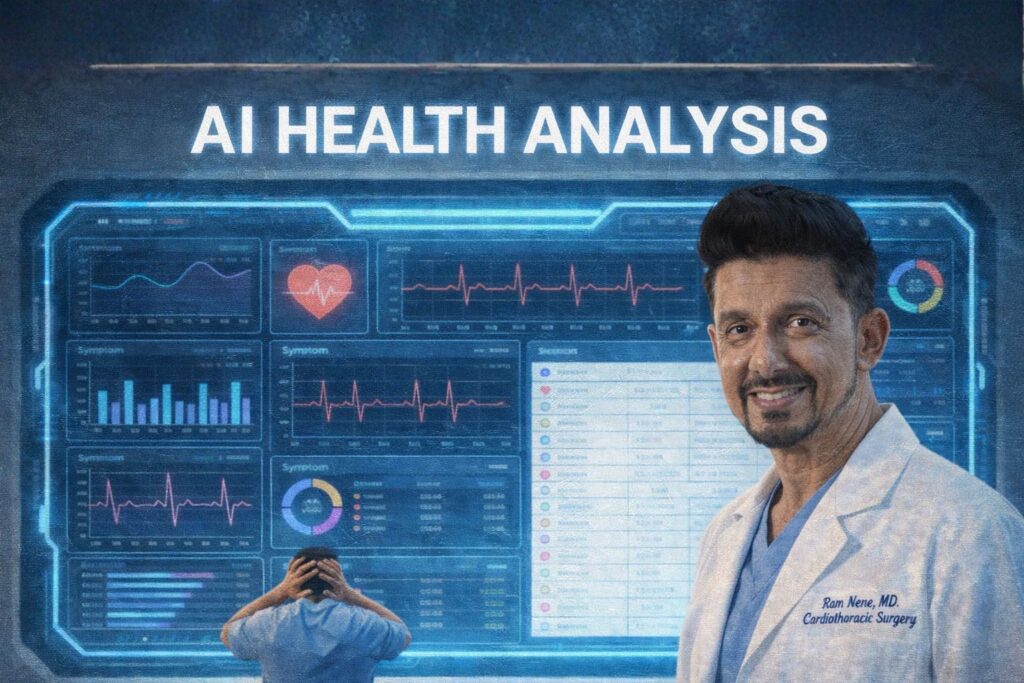
Not long ago, trusting artificial intelligence with your health would have sounded far-fetched. Today, it’s becoming routine.
More and more people are turning to AI tools to understand symptoms, interpret reports, and even guide health decisions. The question is no longer if AI can help.
It’s whether it should be trusted to lead.
There’s no denying how powerful AI has become. It can analyze vast amounts of data in seconds, identify patterns that may not be obvious, and even identify potential risks. In data-heavy scenarios, it can be incredibly precise.
But medicine has never been just about data.
It’s about context.
Medicine does not happen in isolation. AI lacks patient interaction, physical examination & real-life context. The same symptom can mean very different things depending on the individual.
Health is shaped by lifestyle, environment, stress, history – factors that don’t always fit neatly into an algorithm.
AI processes information.
It doesn’t truly understand the person behind it.
And that distinction matters more than most people realize.
The real concern isn’t that AI is always wrong.
It’s that it can feel completely right – even when it isn’t.
That confidence can be misleading. It creates a false sense of certainty in situations that actually require deeper evaluation. And in health, that gap between certainty and reality can be risky.
Because medicine isn’t just pattern recognition.
It’s interpretation, judgment, and accountability.
When a decision is made, someone has to stand behind it. That layer of responsibility is fundamental to healthcare. It’s also something technology, at least today, doesn’t carry.
Trust has never been built on information alone.
It’s built on experience, reasoning, and the ability to see what isn’t immediately obvious.
This isn’t about rejecting AI. Far from it.
AI is one of the most promising tools in modern healthcare. Used well, it can enhance accuracy, support faster decisions, and improve outcomes. It works best as a triage tool – helping with initial screening, early direction, and ongoing monitoring, especially in high patient-load systems like India. It should act as a first filter, not the final decision maker. But its strength lies in assisting -not replacing-human judgment.