

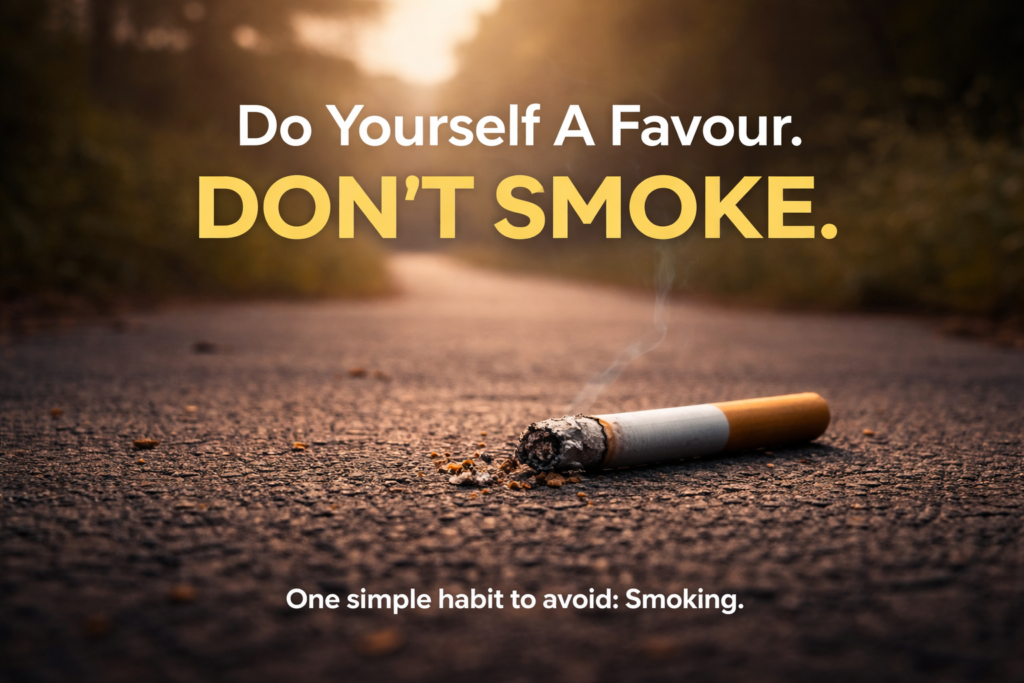
Most people don’t think of smoking as something that’s harming them right now.
It feels small. A break. A pause. A moment.
But inside the body, something very different is happening.
Each cigarette isn’t just smoke – it’s a biological event. Chemicals enter the bloodstream, quietly injuring the lining of your blood vessels. Inflammation begins to build. The lungs, designed for clean oxygen exchange, start losing their efficiency bit by bit. You don’t feel it immediately. That’s what makes it dangerous.
Because smoking doesn’t work like an accident.
It works like a slow accumulation.
What you do today doesn’t show up tomorrow.
It shows up years later.
The mutations triggered by tobacco exposure can take 20 to 30 years to evolve into detectable cancers. Which means the cigarette you smoke in your 20s or 30s may only reveal its consequences much later – when it feels disconnected from the cause.
That’s the illusion.
That nothing is happening.
From a longevity perspective, this is where smoking does its deepest damage. It doesn’t just reduce lifespan by close to a decade – it erodes healthspan. The ability to breathe freely, to move without fatigue, to live without chronic disease… these start slipping away earlier than expected.
And yet, there’s an important truth we often overlook.
The body is not passive in this process – it’s responsive.
When you stop smoking, recovery begins. Circulation improves. Lung function starts to rebuild. The risk of cardiovascular disease begins to come down. It doesn’t happen overnight, but it does happen.
Which means this isn’t just a story about damage.
It’s a story about timing.
The earlier you stop, the more you prevent.
But even if you stop later, you still change the trajectory.
Because smoking doesn’t just take away years from life –
it quietly takes life out of your years.
If you want to understand what’s actually happening inside your body when you smoke—and what changes when you quit—I’ve explained it in detail here: